https://fuelpumpexpress.com

Precast vs. Cast-In-Situ Concrete Cost Savings Analysis

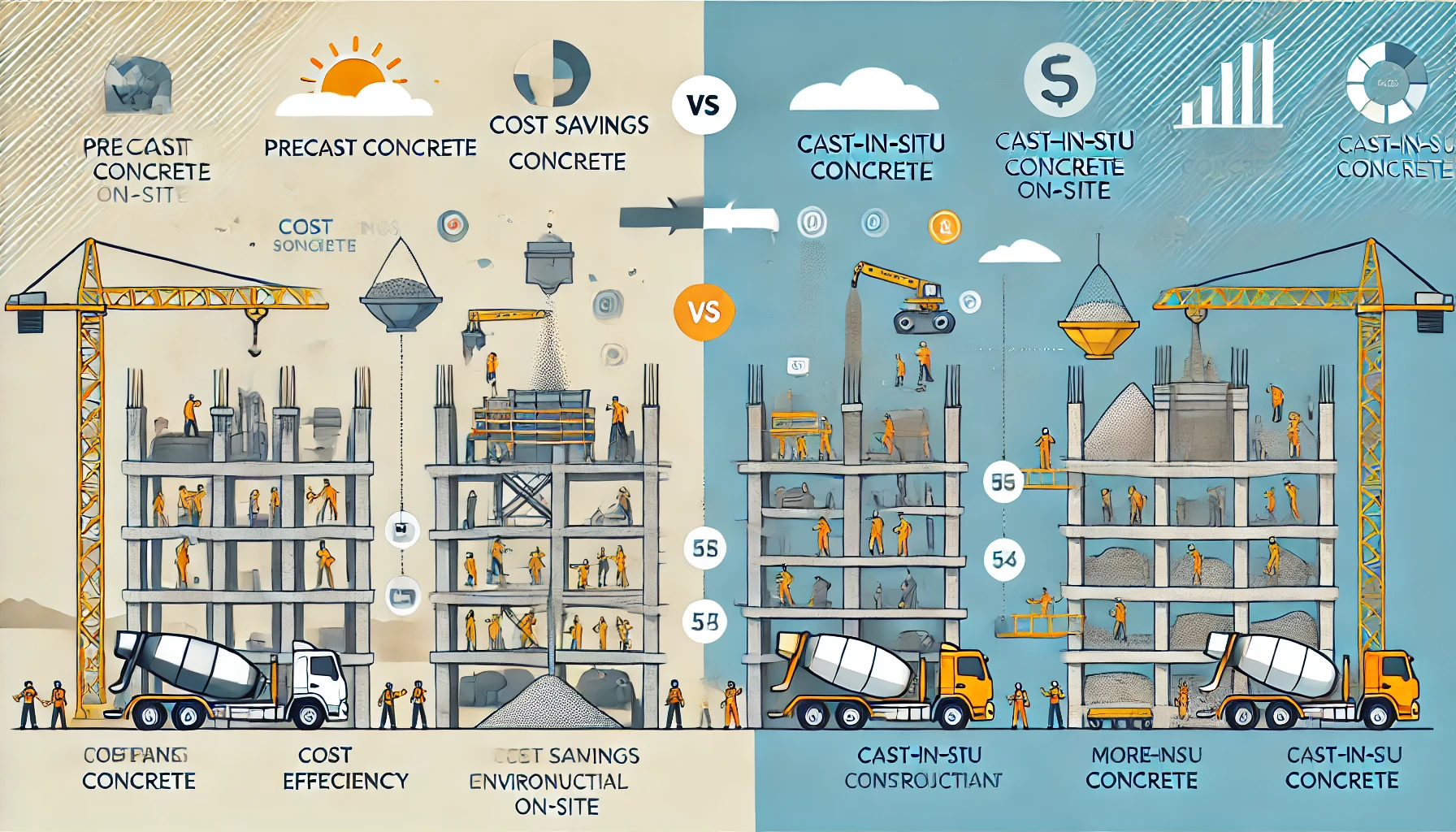
If you’re managing construction projects, you know the drill—tight deadlines, skyrocketing labor expenses, and unexpected delays burning through your budget. But here’s the critical question: is your choice of concrete construction method making things worse?

We dove deep into a comprehensive five-year data study comparing precast and cast-in-situ concrete across material wastage, labor efficiency, project duration, lifecycle maintenance, and environmental impact. The results? Clearer and more surprising than you might expect.

Why the Concrete Debate Matters (Real Numbers Revealed)

Precast Concrete cuts total project costs by up to 70.4% compared to cast-in-situ.Material wastage is drastically reduced, meaning lower expenses.Labor needs shrink by 26%, dramatically cutting wage bills.Construction times drop by 40-50%, speeding up ROI significantly.

Let’s dig deeper.

1. Material Wastage – The Silent Cost Killer

Did you know construction waste quietly erodes your profits? Spilled mixes, damaged materials, and errors accumulate into massive hidden expenses.

Precast Concrete:

  • Manufactured in controlled environments.
  • Virtually eliminates wastage due to precise measurements.
  • Excess materials easily recycled and reused.

Cast-In-Situ Concrete:

  • High wastage from spills, formwork errors, and weather interference.
  • Frequent rework due to weather-related curing issues.

Result: Precast drastically reduces waste, directly boosting your bottom line.

2. Labor Efficiency – Doing More with Less

Labor expenses aren’t just salaries—they also include supervision, insurance, and safety management.

Precast Concrete:

  • Requires 26% fewer workers.
  • No on-site formwork reduces safety risks and insurance overhead.

Cast-In-Situ Concrete:

  • Demands specialized skilled labor, increasing salaries.
  • Greater supervisory requirements elevate indirect labor costs.

Result: Fewer workers and lower indirect costs put precast significantly ahead.

3. Time Savings – Every Day Counts

Time is literally money in construction—each saved day accelerates your return on investment.

Precast Concrete:

  • Reduces overall construction time by 40–50%.
  • Components arrive ready to install, eliminating curing delays.
  • Just-in-time (JIT) logistics enhance project scheduling.

Cast-In-Situ Concrete:

  • Extended construction time due to curing and site preparation.
  • Weather delays significantly push schedules back.

Case Example: A recent high-rise precast project completed 6 months ahead, saving millions compared to an equivalent cast-in-situ build.

Result: Quicker project turnaround boosts your profitability.

4. Lifecycle & Maintenance – Hidden Long-Term Costs

Initial savings can vanish if ongoing maintenance isn’t considered.

Precast Concrete:

  • Superior durability due to factory-controlled quality.
  • Lower ongoing maintenance costs (fewer cracks, minimal repairs).

Cast-In-Situ Concrete:

  • Vulnerable to cracks, weathering, and regular maintenance needs.
  • Higher long-term maintenance expenses can negate initial savings.

Result: Precast’s superior durability protects your profits for years.

5. Environmental & Sustainability Impact – Green Pays Off

Sustainable practices aren’t just ethical—they significantly reduce costs.

Precast Concrete:

  • Lower carbon emissions due to streamlined manufacturing.
  • Minimal waste and reusable materials reduce disposal costs.

Cast-In-Situ Concrete:

  • Increased emissions from on-site batching and transportation.
  • Higher environmental waste management costs.

Result: Precast aligns environmental sustainability with cost savings.

6. Real-World Results: Precast vs. Cast-In-Situ (5-Year Study)

In a major infrastructure comparison, precast concrete demonstrated:

  • 70.4% total project cost savings
  • 45% reduction in construction duration
  • 26% reduction in labor expenses

Cast-in-situ struggled with higher labor costs, extended timelines, and increased overall spending due to frequent delays and waste.

The data confirms precast concrete consistently outperforms on all key metrics.

How Tekance Drives These Savings Even Higher

Making the switch to precast is just the first step. Maximizing its benefits demands precise detailing.

Tekance’s Precast Detailing Services:

  • Generate accurate precast shop drawings to slash material waste.
  • Ensure exact alignment of components, eliminating costly reworks.
  • Streamline scheduling for peak efficiency and cost-effectiveness.

Result: Tekance transforms precast potential into guaranteed savings.

FAQs You Need Answered

Is precast always cheaper than cast-in-situ? Not always. Initial mold costs and transportation might seem higher, but long-term labor and efficiency benefits make precast cheaper overall.

Does precast concrete offer better durability? Absolutely. Factory conditions ensure higher strength, reliability, and reduced repairs.

Are there scenarios where cast-in-situ might be better? Yes. Unique, custom designs with complex geometries sometimes require cast-in-situ flexibility.

Final Verdict: Which Should You Choose?

For projects demanding cost-efficiency, speed, durability, and reduced environmental impact, precast concrete is clearly superior.

And with expert detailing from Tekance, you maximize these advantages, leaving competitors stuck in the concrete past.

Ready to maximize your precast savings? Tekance is here to help.

Learn about Professional Civil Engineering Services for Infrastructure and Construction Projects

Precast Concrete Components: Benefits, Types & Construction Guide

Precast concrete components are revolutionizing construction, making projects faster, stronger, and more cost-effective. But how exactly do they work, and why are they gaining popularity worldwide?

This skyscraper-style guide will take a deep dive into everything you need to know about precast concrete components—what they are, how they compare to traditional construction methods, their benefits, types, and real-world applications.

By the end of this article, you’ll understand why precast concrete is the future of construction.

Key Takeaways

✅ Precast concrete components are manufactured off-site in controlled environments and assembled at the construction site.
✅ They include beams, slabs, walls, columns, stairs, and facades, among others.
✅ Compared to traditional cast-in-place concrete, precast construction is faster, stronger, and more cost-efficient.
✅ Precast concrete components reduce material waste and offer better quality control.
✅ Used in residential, commercial, industrial, and infrastructure projects, including skyscrapers, bridges, tunnels, and stadiums.
✅ Advances in technology and automation are making precast concrete even more efficient and customizable.

What Are Precast Concrete Components?

Precast concrete components are structural elements manufactured in a controlled factory setting before being transported to the construction site. Instead of pouring concrete on-site— which can be time-consuming and error-prone—these components are made with high precision, cured under optimal conditions, and delivered ready to install.

Think of them as Lego blocks for construction—modular, efficient, and easy to assemble.

Precast Concrete vs. Cast-in-Place Concrete: What’s the Difference?

FeaturePrecast ConcreteCast-in-Place Concrete
Manufacturing LocationFactory-made under controlled conditionsPoured and cured on-site
Construction TimeFaster—components are pre-madeSlower—concrete must be poured and set
Quality ControlHigh—uniform production standardsVariable—depends on weather and site conditions
DurabilityStronger—optimized curing processMay be weaker due to external factors
Environmental ImpactLess waste, more efficientHigher material wastage

🔗 Related Read: How Precast Detailing Prevents Costly Errors in Construction

Why Use Precast Concrete Components?

1️⃣ Faster Construction

Since precast elements are pre-made, builders only need to assemble them on-site, reducing construction time by 30% to 50% compared to traditional methods.

2️⃣ Superior Strength & Durability

Precast concrete is stronger than cast-in-place concrete due to precise curing conditions. This makes it more resistant to weather, fire, and heavy loads.

3️⃣ Cost Savings

  • Less labor required → Lower workforce costs.
  • Reduced construction time → Faster project completion.
  • Minimal material waste → More cost-effective in the long run.

4️⃣ Better Quality Control

Precast components are manufactured under strict standards and tested before being transported, ensuring flawless installation and minimal defects.

5️⃣ Eco-Friendly & Sustainable

  • Uses less water and raw materials.
  • Reduces onsite pollution and waste.
  • Many manufacturers use recycled materials to make precast components.

🔗 Industry Insights: 2025 Trends in Precast Concrete Construction

Types of Precast Concrete Components

Precast concrete isn’t one-size-fits-all. It comes in different forms, each designed for specific construction needs.

1. Precast Beams

Used for supporting structures like roofs, bridges, and highways.
Types: I-beams, T-beams, L-beams
Applications: Bridges, stadiums, high-rise buildings

2. Precast Slabs

These flat concrete panels form the floors and ceilings of buildings.
Types: Hollow-core slabs, solid slabs, double-T slabs
Applications: Parking garages, skyscrapers, industrial buildings

3. Precast Walls

Precast walls can be load-bearing or decorative, providing structural support and insulation.
Types: Load-bearing walls, insulated panels, architectural panels
Applications: Homes, malls, offices

4. Precast Columns

Vertical elements designed to carry heavy loads from beams and slabs.
Applications: Multi-story buildings, bridges, tunnels

5. Precast Stairs & Facades

  • Stairs: Quickly installed for residential, commercial, and industrial buildings.
  • Facades: Enhance exterior aesthetics with durable, customized designs.

🔗 Case Study: How Precast Concrete Transformed the Western Harbour Tunnel

How Are Precast Concrete Components Made?

The manufacturing process ensures precision, durability, and superior quality. Here’s how it works:

1️⃣ Mold Creation → A customized mold is prepared.
2️⃣ Concrete Pouring → High-strength concrete mix is poured into the mold.
3️⃣ Reinforcement → Steel bars or fibers are added for extra strength.
4️⃣ Curing → The concrete cures under optimal conditions for maximum durability.
5️⃣ Quality Control → Each component is tested for strength and precision.
6️⃣ Transportation & Installation → Ready components are shipped and assembled on-site.

🔗 More Insights: Innovations in Precast Concrete Manufacturing

Real-World Applications of Precast Concrete

Precast concrete is used in virtually every type of construction, including:

🏠 Residential Buildings → Apartments, townhouses, and custom homes.
🏢 Commercial Spaces → Offices, malls, and entertainment centers.
🌉 Infrastructure Projects → Bridges, tunnels, highways.
🏗 Industrial Facilities → Factories, warehouses, power plants.
🏟 Public & Recreational Spaces → Stadiums, parks, hospitals.

🔗 Explore More: How Precast Concrete is Reshaping Modern Architecture

Frequently Asked Questions (FAQs)

1. Is Precast Concrete More Durable Than Traditional Concrete?

Yes! Precast concrete is cured in optimal conditions, making it stronger, denser, and more durable than cast-in-place concrete.

2. How Long Does Precast Concrete Last?

With proper maintenance, precast concrete structures can last 50 to 100 years.

3. Is Precast Concrete More Expensive?

While the initial cost may be higher, faster construction and reduced labor costs make precast concrete more cost-effective in the long run.

4. Can Precast Concrete Be Customized?

Absolutely! It can be custom-designed in different shapes, sizes, colors, and finishes.

Final Thoughts: Why Precast Concrete is the Future of Construction

Precast concrete components streamline construction, improve quality, and save time and money. With innovative technology and growing sustainability efforts, precast concrete is shaping the future of modern architecture.

💡 Need Expert Precast Detailing Services? Let’s Talk!
Accurate precast detailing to eliminate costly errors.
Faster project timelines with pre-engineered solutions.
Quality-assured components designed for durability.

Learn about The Role of Recycled Materials in Modern Driveway Construction

Precast Detailing Services: Accurate, Efficient & Cost-Effective

Introduction

Precast detailing is a critical component in modern construction, ensuring accuracy, efficiency, and durability in precast concrete structures. As the demand for faster and cost-effective building solutions grows, precast detailing services have become indispensable for architects, engineers, and contractors worldwide.

In this guide, we’ll cover everything you need to know about precast detailing services, including best practices, software, industry standards, and how to choose the right service provider.

1. What is Precast Detailing?

Precast detailing involves creating detailed 2D drawings and 3D models for precast concrete components, such as beams, columns, slabs, panels, and walls. These detailed drawings ensure precise fabrication, transportation, and installation on-site.

💡 Key Benefits of Precast Detailing:
✅ Reduces material waste
✅ Improves construction speed
✅ Ensures structural accuracy
✅ Reduces errors and rework

2. Key Components of Precast Detailing Services

a) Shop Drawings

Shop drawings are essential for fabrication and assembly, providing dimensions, reinforcement details, and connection specifications.

b) Bar Bending Schedules (BBS)

BBS provides detailed reinforcement information, ensuring proper steel cutting, bending, and placement.

c) 3D Modeling & BIM Integration

With Building Information Modeling (BIM), precast detailing enables clash detection, material estimation, and seamless coordination among different trades.

d) Connection Details

Precast structures require precise connection details, ensuring stability, seismic resistance, and durability.

3. Best Software for Precast Detailing

Modern precast detailing relies on advanced software to enhance accuracy and efficiency. Some of the best tools include:

SoftwareFeaturesBest For
Tekla Structures3D modeling, automated reinforcement detailingComplex precast structures
AutoCAD2D drafting, standard detailingSimple precast elements
RevitBIM integration, parametric modelingLarge-scale projects
StruCADSteel and precast detailingStructural steel integration

4. Industry Standards & Compliance

Precast detailing services must adhere to various international codes and standards to ensure quality and safety. Some key standards include:

📌 ACI 318 – American Concrete Institute’s guidelines for structural integrity
📌 BS 8110 – British Standard for structural concrete
📌 IS 456:2000 – Indian Standard for concrete structures
📌 PCI Design Handbook – Precast/Prestressed Concrete Institute standards

Understanding and complying with these standards is essential to delivering high-quality precast detailing services.

5. How to Choose the Right Precast Detailing Service Provider?

Selecting the right precast detailing expert can make or break a project. Here are some factors to consider:

Experience & Portfolio

Look for firms with a proven track record in handling precast detailing for complex projects.

Software Proficiency

Ensure they use industry-leading software like Tekla, Revit, or AutoCAD for precise detailing.

Adherence to Standards

They must comply with international and local building codes to ensure quality.

Cost & Turnaround Time

Compare pricing and timelines to ensure you get high-quality detailing services within your budget.

6. Why Outsource Precast Detailing Services?

Many companies outsource precast detailing to specialized service providers due to the following benefits:

🔹 Cost Savings – Avoid hiring in-house detailing teams and reduce overhead costs
🔹 Access to Experts – Work with highly skilled professionals specializing in precast detailing
🔹 Faster Turnaround – Dedicated teams ensure faster project delivery
🔹 Focus on Core Business – Engineers and contractors can focus on execution rather than detailing

7. Future Trends in Precast Detailing

🚀 AI & Automation in Precast Detailing – AI-driven automated detailing tools are reducing errors and increasing efficiency.
🏗 Digital Twin Technology – Real-time BIM-integrated digital twins are improving project management.
🌍 Sustainable Precast Materials – The rise of eco-friendly precast solutions is transforming the industry.

Staying updated with these trends ensures optimized workflows and competitive advantage.

Final Thoughts

Precast detailing services play a crucial role in modern construction, ensuring efficiency, accuracy, and cost savings. Whether you are an architect, engineer, or contractor, adopting best practices, using the right software, and working with experienced professionals can make a significant difference in project success.

Are you looking for expert precast detailing services? Get in touch with a trusted precast detailing provider to bring precision and efficiency to your next project!

Learn about Commercial & Residential Construction Services: Understanding the Differences and Benefits

Precast Detailing Guide 2025 | Faster & Stronger Construction

Precast detailing is revolutionizing the construction industry by ensuring precision, efficiency, and structural integrity. By planning every component in advance, projects benefit from faster execution, reduced costs, and minimal waste. In this ultimate guide, we will explore everything you need to know about precast detailing, including its significance, key processes, software tools, and future trends.

Key Takeaways

  • Precast detailing enhances accuracy, efficiency, and quality in construction projects.
  • It minimizes material waste and accelerates project timelines.
  • Advanced software like Tekla, AutoCAD, and Revit play a crucial role in the detailing process.
  • Precast concrete is widely used in commercial, residential, and infrastructure projects.
  • Following industry standards ensures compliance and safety.

What is Precast Detailing?

Precast detailing is the process of designing and creating detailed drawings for precast concrete elements before manufacturing. This involves shop drawings, reinforcement detailing, and connection plans, ensuring every element fits perfectly during on-site assembly.

Think of precast elements like Lego blocks—each piece must be meticulously designed to ensure seamless assembly, eliminating errors and maximizing structural strength.

Why Precast Detailing is a Game-Changer in Construction

1. Faster Project Completion

Precast elements are manufactured in a controlled factory environment, leading to faster production and installation compared to on-site concrete pouring.

2. Cost Efficiency

With detailed planning, material waste is significantly reduced, lowering overall construction costs.

3. Enhanced Safety

Factory-made precast elements are more consistent in quality and strength, reducing risks compared to traditional cast-in-place concrete.

4. Superior Structural Integrity

Proper detailing ensures that each precast component fits perfectly, resulting in a sturdy and durable final structure.

Where is Precast Concrete Used?

Precast concrete is used across various sectors, including:

Commercial Buildings – Offices, shopping malls, and warehouses. ✔ Residential Projects – Apartments, villas, and housing complexes. ✔ Infrastructure – Bridges, tunnels, metro stations. ✔ Industrial Structures – Factories, storage units, and parking structures.

Its versatility makes it an essential material in modern construction projects worldwide.

Key Elements in Precast Concrete

  • Precast Slabs – Used for flooring and ceilings, including hollow-core, solid, and double-tee slabs.
  • Precast Columns and Beams – Provide structural support to buildings.
  • Precast Walls – Can be load-bearing or non-load-bearing.
  • Precast Stairs and Landings – Essential for staircases in buildings.

Each element is pre-manufactured, transported, and assembled on-site like a giant puzzle.

Precast Concrete vs. Traditional Cast-in-Place Concrete

FeaturePrecast ConcreteCast-in-Place Concrete
SpeedFaster production & installationSlower due to on-site pouring
Quality ControlMade in a factory with precisionProne to weather and human errors
Cost EfficiencyReduces waste & labor costsMore expensive due to on-site work
DurabilityStronger due to controlled curingMay have inconsistencies

With precast detailing, upcoming industry trends are making construction even more efficient and precise.

Step-by-Step Process of Precast Detailing

1. Understanding Project Requirements

Engineers and architects analyze the project specifications and design needs.

2. Creating 3D Models

Using BIM (Building Information Modeling) software, engineers develop 3D models to visualize the structure.

3. Generating Shop Drawings

Detailed drawings guide the manufacturing of each precast element.

4. Adding Reinforcement Details

Steel reinforcements are incorporated to enhance structural strength.

5. Reviewing & Approving Designs

Thorough quality checks are conducted before production begins, minimizing costly errors.

Top Software for Precast Detailing

  • Tekla Structures – Industry-leading BIM-based detailing tool.
  • AutoCAD – Used for both 2D and 3D precast drawings.
  • Revit – Advanced 3D modeling capabilities for precast elements.
  • StruCAD, Allplan Precast, BricsCAD – Other specialized software used in detailing.

These tools ensure accurate designs, detect potential clashes, and streamline the construction process.

Challenges in Precast Detailing & Solutions

1. Dimensional Accuracy Issues

Solution: Utilize 3D modeling software to detect errors early and ensure precision.

2. Complex Connections

Solution: Standardize joint designs to simplify the assembly process.

3. Transportation & Handling Concerns

Solution: Optimize element sizes to ensure easy transportation and on-site handling.

Maintaining high-quality standards in precast detailing helps prevent major project setbacks.

Future Trends in Precast Detailing (2025 & Beyond)

AI & Automation – AI-powered detailing for error-free designs. ✅ 3D Printing – Faster production of precast components through additive manufacturing. ✅ Sustainability Focus – Incorporating eco-friendly materials for greener construction. ✅ Digital Twins – Real-time tracking and monitoring of precast structures.

With cutting-edge innovations, the future of precast detailing is becoming more efficient, sustainable, and cost-effective.

Final Thoughts

Precast detailing is reshaping the construction industry, making it faster, more cost-efficient, and highly accurate. By leveraging modern software and best practices, builders can ensure high-quality, safe, and durable structures.

Looking for expert precast detailing services? Our team provides precision-focused solutions for your projects—ensuring strength, efficiency, and long-term reliability.

Explore our precast detailing services today and take your construction projects to the next level!

Learn about Commercial & Residential Construction Services: Understanding the Differences and Benefits

Precast Concrete Detailing – Best Practices & Software

1. Introduction

Precast concrete detailing plays a crucial role in modern construction, ensuring high-quality, cost-effective, and durable structures. This guide explores the significance, processes, challenges, and innovations in precast concrete detailing.

What is Precast Concrete Detailing?

Precast concrete detailing involves creating precise design drawings and specifications for concrete elements that are manufactured off-site before being transported to the construction site. These elements include beams, columns, panels, and slabs.

Importance in Modern Construction

With growing demands for efficiency and sustainability, precast concrete detailing helps streamline the building process, reducing on-site labor, material waste, and project timelines.

Benefits of Precast Over Traditional Methods

  • Faster Construction: Precast components are manufactured in controlled environments, reducing weather-related delays.
  • Cost-Effectiveness: Reduces material waste and on-site labor costs.
  • Quality Control: Ensures uniformity and adherence to industry standards.
  • Sustainability: Minimizes environmental impact by optimizing material use and reducing carbon footprint.

2. Understanding Precast Concrete

Definition and Applications

Precast concrete is a construction material produced by casting concrete in a reusable mold, cured in a controlled environment, and transported to the site for assembly. It is widely used in residential, commercial, and infrastructure projects.

Types of Precast Concrete Structures

  • Structural Precast Elements: Beams, columns, and load-bearing walls.
  • Architectural Precast Elements: Facade panels, decorative walls.
  • Infrastructure Components: Bridges, tunnels, pipes.

Key Components of Precast Detailing

  • Drawings and Specifications: Essential for accurate manufacturing and assembly.
  • Reinforcement Details: Ensuring structural integrity.
  • Connection Design: Proper alignment and stability of assembled elements.

3. Key Advantages of Precast Concrete

Speed of Construction

Precast elements are produced simultaneously with site preparation, significantly reducing construction time compared to traditional cast-in-place methods.

Cost-Effectiveness

  • Lower Labor Costs: Reduced on-site labor requirements.
  • Efficient Material Usage: Minimizes waste.
  • Reduced Maintenance: High durability leads to lower long-term costs.

Environmental Benefits

  • Reduced Carbon Footprint: Efficient resource utilization.
  • Waste Minimization: Reusable molds and optimized concrete mix designs.
  • Energy Efficiency: Thermal mass properties improve energy efficiency in buildings.

4. Essential Steps in Precast Concrete Detailing

Initial Design and Planning

A thorough understanding of project requirements, load considerations, and design constraints is crucial before starting the detailing process.

Structural Analysis and Load Calculations

Engineers conduct structural analysis to determine load-bearing capacities and reinforcement needs to ensure stability and durability.

Shop Drawings and Reinforcement Detailing

Detailed drawings include precise measurements, reinforcement placements, and connection details for accurate fabrication and assembly.

5. Precast Concrete Drawings and Standards

Importance of Accurate Shop Drawings

Precise drawings help avoid errors during manufacturing and ensure seamless on-site assembly.

Industry Standards and Compliance

Following standards like ACI, PCI, and Eurocode ensures safety, quality, and regulatory compliance in precast detailing.

Role of BIM (Building Information Modeling) in Precast Detailing

BIM enhances coordination, accuracy, and visualization, reducing errors and improving efficiency in precast detailing.

6. Software for Precast Concrete Detailing

Top Software Tools for Detailing

Various software solutions streamline precast detailing, including:

  • Tekla Structures – Advanced 3D modeling and detailing capabilities.
  • AutoCAD – Widely used for creating precise 2D and 3D drawings.
  • Revit – Integrates BIM technology for enhanced collaboration.

Features and Benefits of Each Software

  • Tekla Structures: Enables parametric modeling and clash detection.
  • AutoCAD: Provides comprehensive drafting tools.
  • Revit: Facilitates intelligent design data management and coordination.

How to Choose the Right Detailing Software

  • Project Complexity: Select software based on project scale and requirements.
  • Collaboration Needs: BIM-compatible tools enhance teamwork.
  • Budget Considerations: Factor in licensing costs and training requirements.

7. Common Challenges in Precast Detailing

Coordination Between Architects and Engineers

Ensuring seamless integration of architectural aesthetics and structural stability requires clear communication and detailed drawings.

Handling Complex Designs

Advanced projects with intricate geometries demand robust software and skilled detailing to maintain accuracy.

Avoiding Common Mistakes in Detailing

  • Insufficient Tolerance Consideration: Leads to assembly issues.
  • Overlooking Load Calculations: Impacts structural stability.
  • Inconsistent Reinforcement Placement: Can compromise durability.

8. Precast Concrete Connections and Joints

Importance of Connections in Structural Stability

Connections play a crucial role in maintaining the strength and integrity of precast structures by ensuring proper load transfer between elements.

Types of Joints Used in Precast Detailing

  • Bolted Connections: Provide ease of assembly and disassembly.
  • Welded Joints: Ensure strong, permanent connections between elements.
  • Grouted Joints: Used for filling gaps and improving load distribution.

9. Precast Reinforcement and Rebar Detailing

Role of Reinforcement in Precast Structures

Reinforcement is crucial in precast concrete to enhance tensile strength and structural durability, reducing the risk of cracking and failure.

11. Frequently Asked Questions (FAQs)

1. How does precast concrete differ from cast-in-place concrete?

Precast concrete is manufactured in a controlled environment and transported to the construction site, whereas cast-in-place concrete is poured and cured on-site.

2. What are the key benefits of using precast concrete?

Precast concrete offers advantages such as faster construction, improved quality control, cost-effectiveness, and enhanced sustainability.

3. What software is best for precast concrete detailing?

Popular software options include Tekla Structures, AutoCAD, and Revit, each offering specialized features for detailed design and modeling.

4. How can BIM improve precast detailing?

BIM facilitates better collaboration, accuracy, and visualization, reducing errors and improving project efficiency.

5. What are common challenges in precast detailing?

Challenges include coordination between professionals, handling complex designs, and avoiding errors in reinforcement placement.

10. Conclusion

Precast concrete detailing is a fundamental aspect of modern construction, ensuring precision, efficiency, and durability. By following best practices, adhering to industry standards, and leveraging advanced software tools, engineers and contractors can optimize their precast detailing processes for long-term success.

Learn about Dual Power Supplies: Circuit Construction and Operation