Understanding Concentric Cable: Structure, Advantages & Industrial Applications
In modern electrical distribution systems, concentric cable plays a critical role in ensuring reliable power transmission and grounding performance. This specialized type of cable is designed with a unique concentric construction, providing exceptional mechanical strength, flexibility, and electrical safety. For engineers and procurement professionals, choosing the right concentric cable is essential for maintaining efficiency and minimizing electrical losses in industrial and commercial installations.
HNBF Power, a trusted global manufacturer of overhead conductors and power cables, produces concentric cables engineered for high performance, long life, and consistent conductivity in demanding environments.
What Is a Concentric Cable?
A concentric cable is a type of electrical conductor where the neutral or grounding wires are arranged concentrically around the insulated phase conductor. The outer conductors form a cylindrical layer over the inner core, providing both electrical continuity and mechanical protection.
This design ensures effective fault current return paths and electromagnetic balance, reducing interference and voltage fluctuations. Concentric cables are widely used for low-voltage distribution, metering systems, and underground service connections.
Construction of Concentric Cable
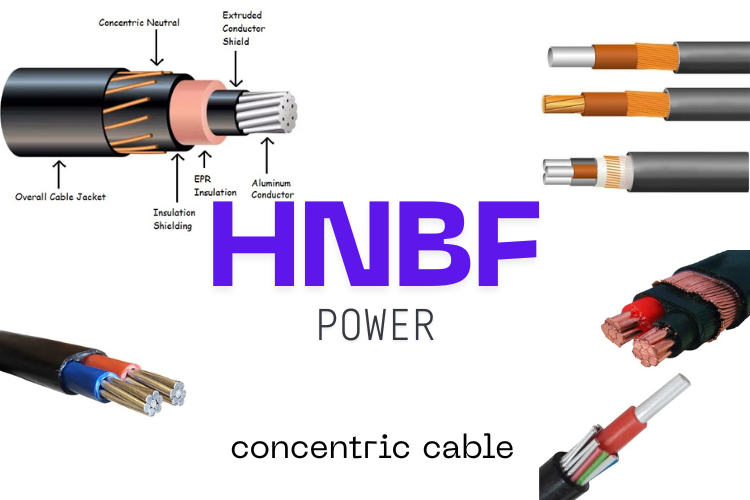
A typical concentric cable manufactured by HNBF Power consists of the following layers:
- Central Conductor: Usually made of annealed copper or aluminum, responsible for carrying the primary current.
- Insulation Layer: High-grade XLPE (cross-linked polyethylene) or PVC insulation to provide electrical isolation.
- Concentric Neutral Conductors: Bare or tinned copper wires helically wound around the insulation, ensuring consistent grounding and neutral paths.
- Outer Sheath: A durable PVC or PE jacket that offers protection against moisture, abrasion, and environmental stress.
This robust structure allows the cable to withstand mechanical tension and harsh operating conditions, making it ideal for underground and service entrance installations.
Key Features and Advantages
HNBF Power’s concentric cables are engineered with precision to meet international standards such as IEC, ASTM, and BS. The key advantages include:
- Enhanced Electrical Safety – The concentric neutral provides a uniform potential gradient, reducing the risk of electric shock and system imbalance.
- Excellent Fault Current Management – The evenly distributed neutral wires enable quick fault current return, improving protection system efficiency.
- Durability and Flexibility – Designed for easy installation and long operational life, even in confined or rugged environments.
- Low Electromagnetic Interference (EMI) – The concentric structure minimizes magnetic field emissions and interference with nearby communication lines.
- Reliable Grounding and Shielding – Ensures stable grounding for residential, industrial, and utility power networks.
Applications of Concentric Cable
Concentric cables are versatile and suitable for a wide range of applications, particularly where safety and reliability are priorities. Common uses include:
- Low-Voltage Power Distribution – Supplying electricity to residential and commercial buildings.
- Underground Service Connections – Ideal for buried electrical systems due to their robust insulation and protective sheath.
- Street Lighting Circuits – Efficient grounding and reduced voltage drop make them suitable for outdoor lighting systems.
- Metering and Panel Wiring – Reliable connections between meters, distribution panels, and service points.
- Industrial Electrical Systems – Used in plants and substations for stable and safe power transmission.
HNBF Power provides customized concentric cable designs for different operational voltages, conductor materials, and environmental conditions, ensuring optimal performance for each application.
Quality Assurance and Compliance
At HNBF Power, quality control is integral to the manufacturing process. Every concentric cable undergoes rigorous testing for:
- Conductor resistance and continuity
- Insulation integrity
- High-voltage endurance
- Mechanical tensile strength
- Thermal stability under load
By maintaining compliance with IEC 60502 and ASTM B standards, HNBF Power ensures that every product meets global performance expectations for safety, durability, and reliability.
FAQs About Concentric Cable
1. What makes concentric cable different from regular LV power cable?
Concentric cables feature neutral or grounding conductors wrapped around the insulated core, providing superior fault current return and EMI protection compared to standard LV power cables.
2. Can concentric cables be used outdoors or underground?
Yes. Their durable outer sheath and insulation make them suitable for both outdoor exposure and direct burial applications.
3. What materials are typically used for the conductors?
HNBF Power manufactures concentric cables using high-purity copper or aluminum conductors, depending on project requirements and conductivity needs.
4. Are concentric cables available in different voltage ratings?
Yes, they are available in various voltage classes commonly up to 600/1000V for residential, commercial, and industrial networks.
5. How can I choose the right concentric cable for my project?
Selection depends on voltage level, installation type, conductor material, and environmental conditions. HNBF Power’s engineering team can assist in specifying the most efficient and compliant solution.
Conclusion
Concentric cables represent a reliable and efficient solution for modern electrical distribution systems, offering superior grounding, safety, and performance. For engineers and project managers seeking dependable concentric cable solutions, HNBF Power stands out as a global leader in precision cable manufacturing.
Contact HNBF Power today to discuss your customized concentric cable requirements and experience world-class quality built for long-term power reliability.
You have not enough Humanizer words left. Upgrade your Surfer plan.